Best Nature-Based Schools in India (2026): Forest & Alternative Schools for Holistic Child Development
Discover the best nature-based and alternative schools in India like Sholai School. A curated guide for parents seeking holistic, child-centric education beyond traditional schooling.
Nidhi Niharika
4/20/20263 min read
Dear Parents,
Over the past few decades, I have observed a quiet but powerful shift in the questions parents are beginning to ask.
Not long ago, the focus was singular:
Which school has the best results?
Today, a different question is emerging—one that reflects deeper awareness:
What kind of human being is my child becoming?
This shift is significant. Because education, in its truest sense, has never been about information alone. It has always been about the formation of the human mind, the sensitivity of the heart, and the balance of the body.
And it is here that many conventional systems fall short.
Increasingly, research in child development, neuroscience, and education suggests that:
children learn best in emotionally safe environments
unstructured exploration enhances creativity and problem-solving
connection with nature regulates the nervous system and attention span
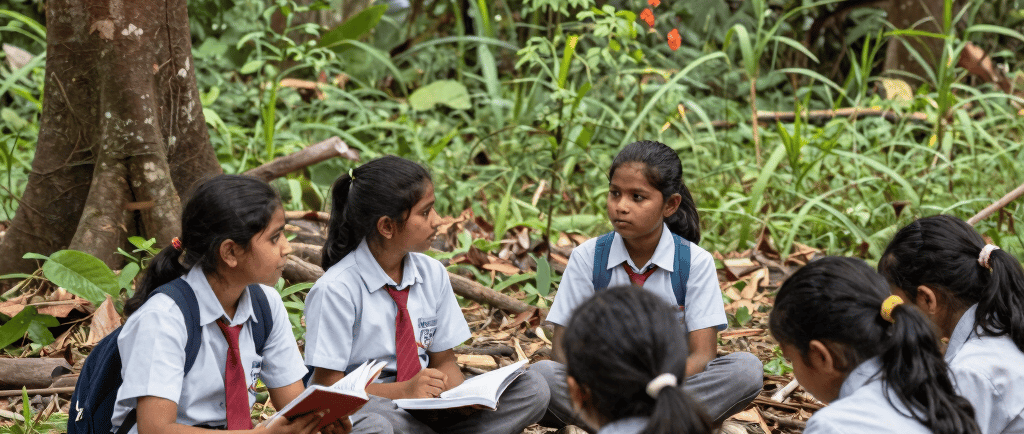
It is not surprising then, that many parents are now turning toward nature-based and alternative schools—spaces that attempt to restore what modern education has gradually taken away.
This article is an attempt to thoughtfully present some of the most meaningful nature-based learning environments in India—particularly for children aged 7 and above—while also helping you understand what truly defines such spaces.
🌱 What Defines a Nature-Based School?
Before exploring specific institutions, it is important to distinguish between appearance and philosophy.
A school surrounded by trees is not necessarily a nature-based school.
A truly nature-integrated learning environment:
embeds nature into the daily rhythm of learning
values experience over instruction
allows children to engage with real-world processes—growing food, building, observing ecosystems
fosters attention, stillness, and awareness
Such environments do not treat nature as a subject.
They treat it as a teacher.
🌿 Leading Nature-Based Schools in India
🌳 Sholai School (Tamil Nadu)
Situated in the Palani Hills, Sholai School represents one of the most immersive examples of ecological education in India.
Here, sustainability is not part of a curriculum—it is embedded in daily life. Children participate in farming, understand energy systems, and engage in hands-on work that connects them to the land.
The absence of competitive pressure allows for the development of intrinsic motivation, a trait often diminished in conventional settings.
Sholai is not merely an alternative school; it is a living model of education aligned with ecological consciousness.
🌾 Peepal Grove School (Andhra Pradesh)
Peepal Grove offers a compelling blend of simplicity, community living, and academic engagement.
With a relatively small student body, the school fosters close relationships between teachers and students, which research consistently identifies as a key factor in effective learning.
The rural setting supports a slower pace of life, encouraging children to develop attention, responsibility, and independence.
🌳 Rishi Valley School (Andhra Pradesh)
Founded on the educational philosophy of Jiddu Krishnamurti, Rishi Valley places equal emphasis on inner awareness and environmental sensitivity.
Spread across an expansive natural landscape, the school integrates ecological conservation with academic learning.
Students are encouraged to observe, question, and engage deeply with their surroundings—developing not just intellect, but clarity of perception.
🌲 Sarang (Kerala)
Sarang represents a more radical departure from conventional schooling.
Constructed using natural materials and situated within a forested environment, it prioritizes life skills, self-sufficiency, and community living over formal academics.
Children engage in cooking, farming, and building—activities that cultivate resilience, adaptability, and practical intelligence.
Such environments are particularly valuable in developing what modern education often overlooks:
👉 the ability to live meaningfully.
🌿 The Valley School (Bangalore)
Also rooted in Krishnamurti’s philosophy, The Valley School offers a more structured yet still deeply reflective environment.
The campus itself—rich with biodiversity—plays a central role in the learning process.
The school balances academic rigor with freedom of inquiry, making it suitable for families seeking an alternative without completely stepping away from formal structures.
🌾 Choosing the Right Environment
It is neither practical nor advisable to search for a universally “best” school.
Instead, the more meaningful inquiry is:
👉 What kind of environment allows my child to flourish?
Broadly, parents may consider:
Deep alternative ecosystems
(e.g., Sholai, Sarang)
→ suited for those seeking a complete reimagining of educationBalanced alternative environments
(e.g., Peepal Grove, Rishi Valley)
→ offering both academic grounding and holistic growthStructured yet progressive schools
(e.g., The Valley School)
→ integrating alternative philosophy within familiar frameworks
An Important Consideration
It is essential to recognize that schooling alone cannot determine a child’s development.
A child spends a significant portion of their formative years outside the classroom. The emotional climate at home, the nature of parent-child interactions, and the values lived daily play an equally—if not more—important role.
Even the most thoughtfully designed school cannot compensate for:
chronic stress
lack of emotional connection
excessive control or pressure
Where the Real Work Begins
In my experience, the most meaningful educational shifts occur not when parents change schools, but when they begin to reflect on their own conditioning.
This involves:
rethinking success
understanding behavior beyond surface reactions
creating environments of trust and psychological safety
Education, ultimately, is a shared journey between the child, the school, and the parent.
Education is not merely preparation for life.
It is life itself.
The environments we choose, the conversations we have, and the awareness we bring—these shape not only our children’s futures, but the kind of society they will one day create.
The question, then, is not simply:
👉 Which school is right?
But rather:
👉 What kind of world are we preparing our children to live in—and contribute to?
🌸 The answer to that begins much closer to home than we often imagine.